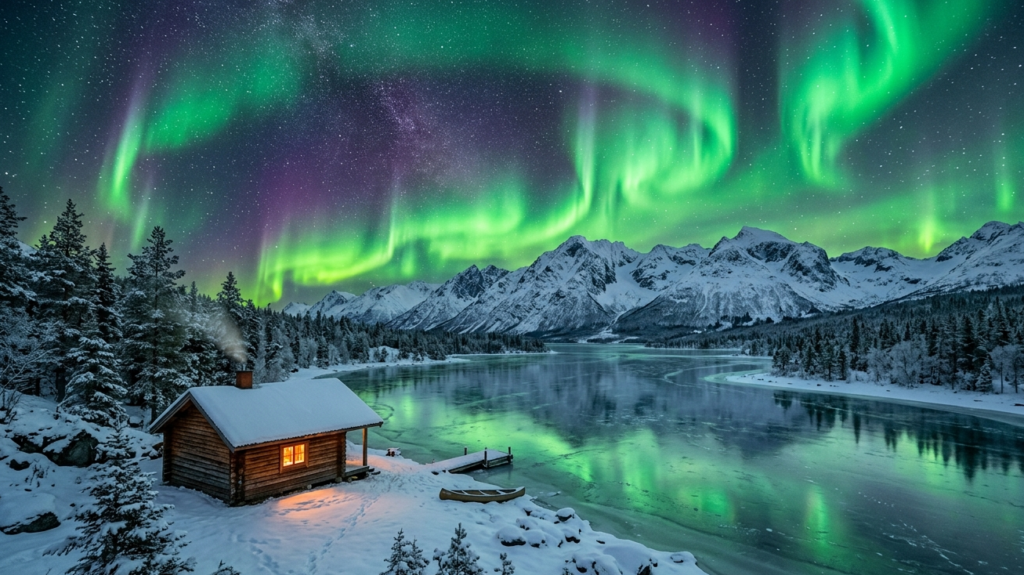
There’s a primal magic in the Northern Lights. It’s that feeling of looking up at a sky painted with ethereal greens, purples, and reds, and understanding, for a fleeting moment, just how vast and magnificent the cosmos truly is. It’s an ancient dance between our sun and our planet, a celestial ballet that has captivated humanity for millennia. And while once it was a phenomenon largely left to chance encounters in the far north, today, with a little knowledge and some digital savvy, you can become your own aurora hunter, predicting and pursuing this breathtaking spectacle.
Forget waiting for an alert to pop up on your phone, often hours after the best display has faded. Imagine understanding the whispers of the solar wind, deciphering the magnetic currents swirling around our globe, and stepping outside just as the heavens ignite. While an exact, minute-by-minute guarantee remains elusive – this is nature, after all – mastering the art of aurora forecasting transforms you from a passive observer into an informed participant in one of Earth’s most stunning natural phenomena.
Why Become Your Own Aurora Forecaster?
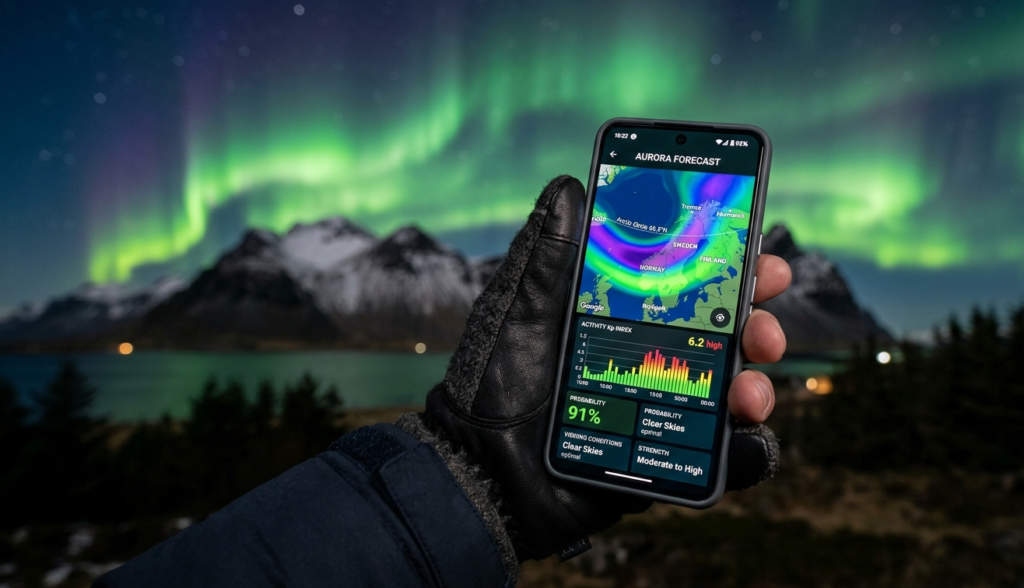
The thrill of the chase is part of the aurora experience. But beyond that romantic notion, there are practical advantages to understanding the science yourself:
- Timeliness: Official Kp index forecasts update every few hours. Auroral substorms, which often bring the most dramatic displays, can flare up and die down within 30 minutes. By monitoring real-time data, you can catch these brief but intense periods that automated alerts might miss or report too late.
- Locality: The Kp index is a global average. What’s happening over Canada might be different from what’s happening over Scandinavia, or even a few hundred miles south. Learning to read maps and dynamic data allows you to assess the likelihood of seeing the aurora precisely from your location.
- Deeper Understanding: Moving beyond a simple “yes/no” forecast unveils the intricate physics at play. You’ll grasp why the aurora is appearing, connecting you more profoundly to the cosmic forces shaping our planet.
- Empowerment: There’s a satisfaction in deciphering complex data and making your own predictions. It’s like becoming a cosmic weatherperson, predicting weather patterns not just on Earth, but in the space around it.
The Cosmic Orchestra: Understanding the Aurora’s Ingredients
To forecast the aurora, we first need to understand its fundamental components. Think of it as a recipe with three main ingredients, all originating from our sun:
- The Solar Wind: Our sun is constantly ejecting a stream of charged particles – electrons and protons – into space. This is the solar wind. Its speed and density are crucial.
- Speed: Faster solar wind carries more energy towards Earth. Wind speeds above 450 km/s start to become interesting, with anything above 550 km/s significantly increasing the chances of a display [aurorago.app]. Extremely fast winds (over 700 km/s) often herald major geomagnetic storms.
- Density: This refers to the number of particles per cubic centimeter. Higher density means more “fuel” for the aurora. When both speed and density are high, the “dynamic pressure” on Earth’s magnetosphere increases, leading to more energetic auroral processes [aurorago.app].
- The Interplanetary Magnetic Field (IMF): The “Zipper” Effect: This is arguably the most critical factor, often referred to as the Bz component [aurorago.app]. The solar wind carries its own magnetic field. When this field’s north-south component (
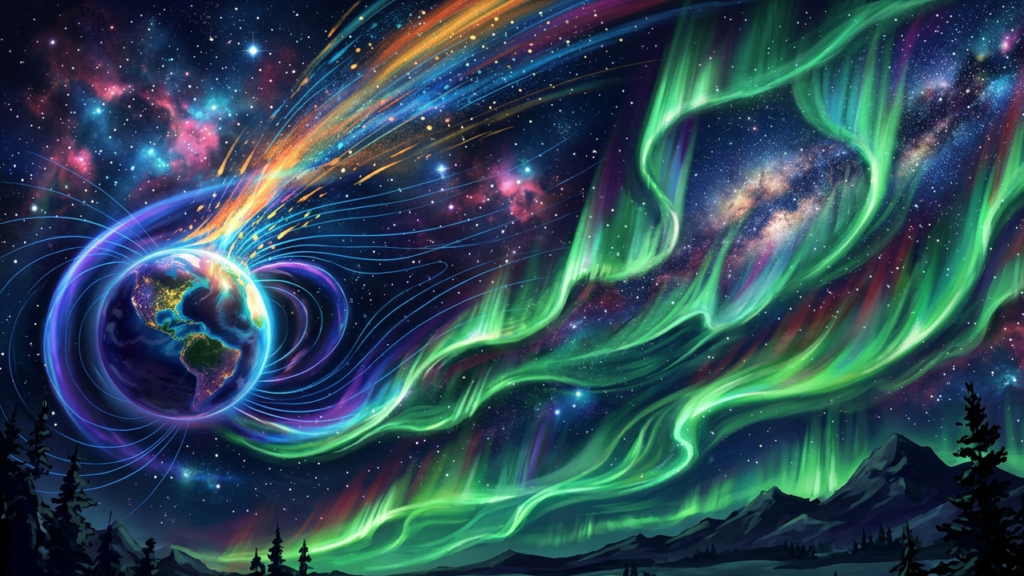
Bz) points south (negative), it aligns opposite to Earth’s own northward-pointing magnetic field. This opposition is key.- Imagine two magnets. If you try to push their north poles together, they repel. If you align a north and a south pole, they attract. The same principle applies here. When Bz is southward, it essentially “unzips” a part of Earth’s magnetic shield, allowing solar particles to stream into our upper atmosphere.
- A sustained negative Bz (especially below -5 nT, and even more so below -10 nT) is a strong indicator of impending or ongoing auroral activity [aurorago.app]. Conversely, a northward (positive) Bz suppresses aurora, as it strengthens Earth’s magnetic defense.
- Earth’s Magnetic Field: Our Planetary Shield: This invisible shield protects us from the full brunt of the solar wind. But where the solar wind’s charged particles penetrate this shield, typically around the magnetic poles, they collide with atmospheric gases (oxygen and nitrogen). These collisions excite the gas atoms, causing them to emit light – our beloved aurora. Green and red hues usually come from oxygen, while nitrogen contributes blues and purples [economictimes.indiatimes.com].
Your Aurora Hunting Toolkit: Essential Data and Where to Find It
To effectively forecast the aurora, you’ll need to familiarize yourself with a few key resources, many of which are provided by the NOAA Space Weather Prediction Center (SWPC) [swpc.noaa.gov].
- NOAA’s 30-Minute Aurora Forecast (OVATION Model): This is your real-time visual guide [swpc.noaa.gov]. The OVATION (Oval Variation, Assessment, Tracking, Intensity, and Online Nowcasting) model uses real-time solar wind data to predict the aurora’s location and intensity.
- What it shows you: A green oval (or red for more intensity) centered on Earth’s magnetic poles, indicating where the aurora is currently or will soon be visible. The sunlit side of Earth is also shown, reminding you that aurora isn’t visible during daylight [swpc.noaa.gov].
- How to use it: If the oval covers your location (or is near enough to your northern horizon), you have a chance. The forecast has a lead time of 30-90 minutes, giving you a crucial window to prepare and head outside [swpc.noaa.gov].
- Solar Wind Data Dashboard (e.g., Aurora Go app, NOAA Space Weather Now): This is where you track the critical speed, density, and especially the Bz component in real-time [aurorago.app].
- Watch for:
- Bz: A sudden, sustained drop into negative territory (e.g., -5 nT or lower) is your primary trigger.
- Speed: Look for speeds above 400-450 km/s and increasing trends.
- Density: Elevated density (above 5-10 p/cc) combined with good speed and negative Bz is a potent mix.
- The Lag Time: Remember, these measurements are taken at the L1 observation point, about 1.5 million kilometers from Earth. It takes the solar wind 15-60 minutes to travel from L1 to Earth. This is your precious lead time! [aurorago.app]
- Watch for:
- Kp Index (Geomagnetic Storm Scale): While not ideal for real-time chasing, the Kp index (ranging from 0-9) provides a general measure of global geomagnetic activity over three-hour periods.
- What it tells you:
- Kp 0-3: Quiet, aurora typically confined to very high latitudes.
- Kp 4-6: Active, aurora visible at mid-latitudes (e.g., parts of Canada, Scotland) [auroramap.app].
- Kp 7+: Geomagnetic storm, aurora visible at lower latitudes (e.g., parts of the northern U.S. and Europe) [auroramap.app].
- Limitations: It’s an average and updates slowly, so don’t rely solely on it for immediate viewing decisions [aurorago.app]. However, a forecast of high Kp (like the recent prediction of potential Kp 7+ activity across 18 U.S. states [economictimes.indiatimes.com]) means there’s a strong potential for widespread visibility.
- What it tells you:
- Local Weather Forecast (Cloud Cover!): Even with perfect space weather, if your sky is covered in clouds, you won’t see a thing. Check hourly cloud forecasts for your chosen viewing spot.
- Moon Phase and Light Pollution: A bright full moon can wash out fainter auroral displays. Similarly, city lights create “light pollution” that severely hinders visibility. Seek out dark, rural locations with minimal artificial light for the best experience [economictimes.indiatimes.com].
Real-Time Forecasting: Your Step-by-Step Workflow
Here’s how an experienced aurora hunter might approach an evening when conditions look promising:
- Pre-Trip Planning:
- Check the long-range Kp forecast: If it’s elevated (Kp 4+), it signals a potential opportunity. Solar Cycle 25, which peaked in late 2024 and remains strong through 2026, generally offers prime conditions for more frequent and intense displays [auroramap.app].
- Identify dark sky locations: Rural areas away from city lights are crucial. Elevation also helps.
- Check cloud cover: This is non-negotiable. No clouds, no aurora.
- Note moon phase: A new moon period is ideal for seeing fainter displays.
- Monitor in Real-Time (Starting a few hours before local magnetic midnight – roughly 11 PM to 2 AM local time):
- Open your data dashboard: Focus heavily on the Bz component. Has it been negative for a while? Is it consistently dropping further negative?
- Watch speed and density: Are they elevated? Is there a sudden increase?
- Check the NOAA 30-minute OVATION map: Is the auroral oval expanding towards your latitude? Is your location within the green or red bands?
- Be patient: Aurora activity can wax and wane. It might start faint, build, and then fade again. Give your eyes at least 30 minutes to adjust to the darkness once you’re outdoors [economictimes.indiatimes.com].
- The “Go Now” Signal:
- The strongest “go now” signal is a sustained and significantly negative Bz (e.g., -10 nT or lower for 30+ minutes), combined with higher solar wind speeds (e.g., 500 km/s or more), and the OVATION map showing the aurora oval directly over or just to your north.
- If you see a sudden, sharp drop in Bz to strong negative values, you might have a 15-60 minute heads-up before the show truly begins.
Mastering the Nuances: Beyond the Basics
As you gain experience, you’ll start to recognize more subtle patterns:
- Substorm Dynamics: Major aurora events often follow a pattern: an energy buildup phase (Bz turns negative), followed by a sudden “onset” (brightening), an “expansion phase” (rapid intensification and movement, often the best for photography), and finally a “recovery phase” as activity gradually subsides [aurorago.app].
- Coronal Mass Ejections (CMEs): These massive expulsions of plasma and magnetic field from the sun are the primary drivers of very strong geomagnetic storms. If NOAA issues a CME “Impact Watch,” it means a significant aurora event is likely 24-48 hours later [auroramap.app].
- The 27-Day Forecast: The sun rotates roughly every 27 days. If a particular active region on the sun caused a strong aurora display last month, there’s a chance it will cause another when it rotates back into view [auroramap.app].
Common Pitfalls for the Aspiring Aurora Chaser
- Reliance solely on Kp: As mentioned, Kp is a macro-level indicator. It’s good for planning, but insufficient for precise, real-time decisions.
- Ignoring Bz: A high Kp with a positive Bz component might yield very little aurora. Always prioritize the Bz direction.
- Expecting instant results: The magnetosphere needs time to react to changes in solar wind. Patience is paramount.
- Giving up too early: Many of the most spectacular displays happen around magnetic midnight. If you head home too soon, you might miss the peak.
- Forgetting local conditions: Even the most intense aurora will be invisible through thick clouds or heavy light pollution.
Beyond the Naked Eye: Photographing the Aurora
Often, the aurora appears brighter and more vibrant through a camera lens than to the naked eye, particularly with fainter displays [economictimes.indiatimes.com]. This means even if you see a subtle glow, your camera might capture stunning colors.
- Tripod: Essential for long exposures.
- Manual Focus (to infinity): Autofocus struggles in the dark.
- Wide Aperture (f/2.8 or wider): Lets in more light.
- Longer Shutter Speed (5-15 seconds): Captures more light and movement. Adjust based on aurora intensity – shorter for brighter, more dynamic displays; longer for fainter, more diffuse ones [auroramap.app].
- ISO (1600-3200): Balances light sensitivity with noise. Experiment to find your camera’s sweet spot.
The Human Element: More Than Just a Light Show
Ultimately, chasing the aurora is more than just interpreting data; it’s about connecting with something profound. It encourages us to step outside, away from our screens, and stare up at the night sky with wonder. It’s a reminder of our planet’s place in a dynamic cosmic system, a spectacular interplay of physics that transforms invisible particles into a canvas of shifting, ghostly light.
Whether you’re a seasoned astronomer or a first-time sky-gazer, learning to forecast the aurora enriches the experience immeasurably. It transforms the waiting into an exciting detective game, and the sighting into a moment of hard-won triumph. The sky rewards those who understand its language, and by becoming your own aurora forecaster, you open yourself to a unique dialogue with the universe. So, next time the conditions align, pack your thermos, find your dark spot, and prepare to witness the heavens dance – a spectacle you’ve helped predict, and earned the right to behold.