
April 14th isn’t just another date on the calendar. To most, it’s just a spring day. But to a growing community of scientists, engineers, and curious thinkers, it marks World Quantum Day. It’s a day dedicated to the bizarre, the microscopic, and the revolutionary.
But why April 14th? And why should someone who isn’t a physicist care about things like “superposition” or “entanglement”? To understand that, we have to look at how a tiny number changed our entire understanding of reality.
The Magic of 4.14: Why Today?
Every celebration needs a reason, and in the world of science, we love a good “nerd” reference. World Quantum Day is celebrated on April 14 because of the fundamental constant that governs the quantum world: Planck’s Constant.
In scientific notation, the rounded value of Planck’s constant is approximately $6.63 \times 10^{-34} \text{ J}\cdot\text{s}$. However, another way to express it (in terms of electron volts) starts with the digits 4.14.
Max Planck, the “father of quantum theory,” discovered that energy isn’t a continuous flow like water; it comes in tiny, discrete packets called “quanta.” This discovery in 1900 was the spark that ignited a revolution, moving us away from the predictable “billiard ball” physics of Isaac Newton into the weird, fuzzy reality of the subatomic.
What Exactly is Quantum Physics? (A Human Translation)

If you feel confused by quantum physics, congratulations—you’re doing it right. As the legendary Richard Feynman once said, “If you think you understand quantum mechanics, you don’t understand quantum mechanics.”
At its heart, quantum physics is the study of matter and energy at the most fundamental level. It’s the rulebook for the very small (atoms and subatomic particles). The catch? The rules for the “very small” are nothing like the rules for the “big things” we see every day.
1. Superposition: The Art of Being Two Things at Once
In our world, a light switch is either ON or OFF. In the quantum world, an electron can be in a state of superposition, meaning it is effectively in both states—and every state in between—at the same time. It only “chooses” a state when we look at it.
2. Entanglement: “Spooky Action at a Distance”
Imagine two magic dice. You keep one in Chennai and send the other to London. When you roll yours and get a 6, the one in London instantly becomes a 6, every single time, regardless of the distance. Einstein called this “spooky action at a distance.” It’s a connection that transcends space.
The First Quantum Revolution: You’re Already Using It
A common misconception is that quantum physics is “the future.” The truth is, we’ve been living in a quantum world for decades. This is what historians call the First Quantum Revolution.
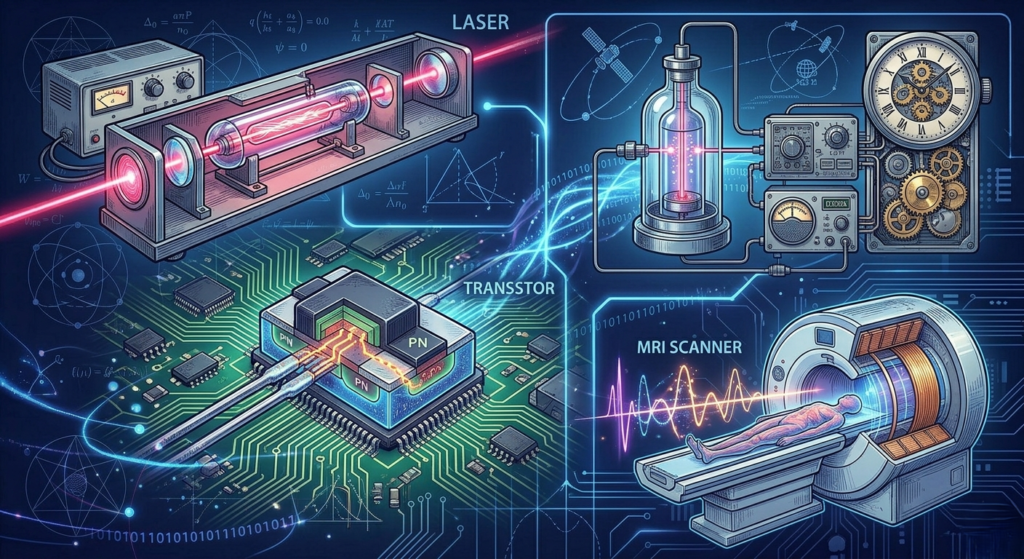
Without our understanding of quantum mechanics, the following wouldn’t exist:
- The Transistor: The building block of every smartphone and computer.
- Lasers: Used in everything from barcode scanners to eye surgery.
- MRI Machines: Utilizing the “spin” of atoms to see inside the human body.
- GPS: Which requires quantum-accurate atomic clocks to tell you where you are on a map.
We aren’t just celebrating a theory; we are celebrating the foundation of the modern global economy.
The Second Quantum Revolution: What’s Coming?
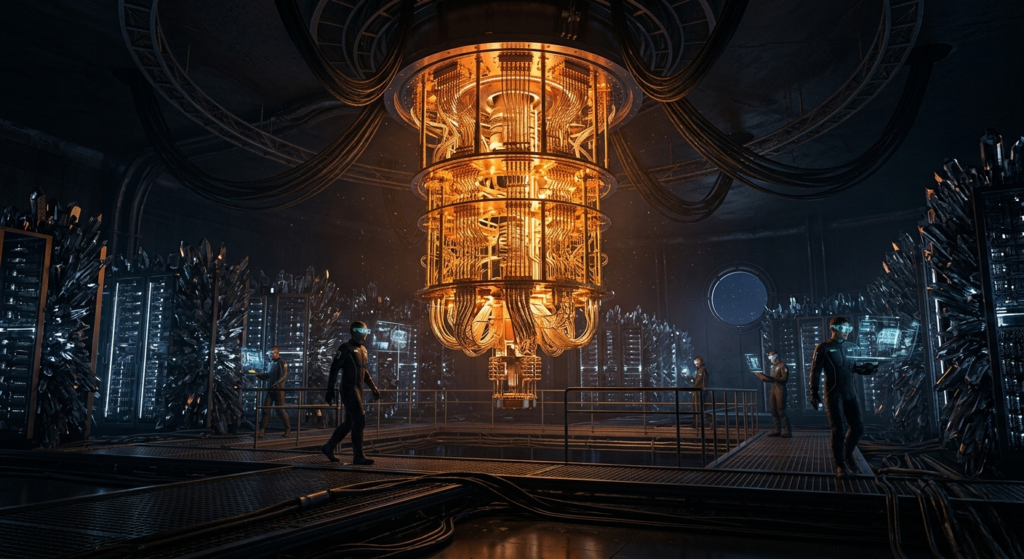
World Quantum Day is as much about the future as it is about history. We are currently entering the Second Quantum Revolution. This is where we stop just observing quantum effects and start actively manipulating them.
Quantum Computing: The Ultimate Upgrade
Traditional computers use bits (0s or 1s). Quantum computers use Qubits. Because of superposition, a quantum computer can process vast amounts of data simultaneously.
- Medicine: Simulating new drugs at a molecular level could take weeks instead of decades.
- Climate: Creating new catalysts to capture carbon from the atmosphere.
- Logistics: Solving complex puzzles like global shipping routes in seconds.
Quantum Cryptography: The Unhackable Web
In a world where cyber-attacks are constant, quantum key distribution (QKD) offers a “holy grail” of security. Because measuring a quantum system changes it, any attempt to eavesdrop on a quantum message would instantly be detected.
Why Should We Celebrate?
You might ask, “Why do we need a dedicated day for this?”
- Democratizing Science: For too long, quantum physics was seen as a “genius-only” club. World Quantum Day aims to bring these concepts to schools and homes. It’s about showing a kid in a small town that they can be the one to solve the next big physics puzzle.
- Global Collaboration: Science has no borders. On April 14th, events happen in over 65 countries. It’s a reminder that human curiosity is a universal language.
- Economic Readiness: As quantum technology grows, we will need “quantum-literate” workers—engineers, coders, and even lawyers who understand how these systems work.
How You Can Participate (Even if You Aren’t a Scientist)
You don’t need a PhD to join in. Here’s how you can mark the day:
- Watch a Documentary: Look up “The Quantum Indians” or “Jim Al-Khalili’s Quantum” series.
- Read a Book: Try Reality Is Not What It Seems by Carlo Rovelli. It’s poetic and easy to follow.
- Try a Quantum Game: There are apps like “Hello Quantum” that teach you the logic of qubits through puzzles.
- Talk About It: Share a “fun fact” about entanglement at dinner. (Warning: You might sound like a nerd, but it’s a cool kind of nerd).
Final Thoughts: The Humility of the Unknown
World Quantum Day is a celebration of humility. It reminds us that even though we’ve built cities and landed on the moon, we are still just scratching the surface of how the universe truly functions.
The quantum world tells us that reality is more interconnected, more vibrant, and more mysterious than we ever imagined. It teaches us that “impossible” is just a word for something we haven’t found the quantum shortcut for yet.
So, next time you look at your smartphone, remember: there are billions of tiny particles inside it performing a “quantum dance” just so you can send a text. That, in itself, is worth a celebration.
Happy World Quantum Day!
Note: Science is a journey, not a destination. Whether you’re a student or a retiree, the quantum world has a place for your curiosity. Keep asking “why.”